The Marketing Tax Hidden in Your Contractor Quote
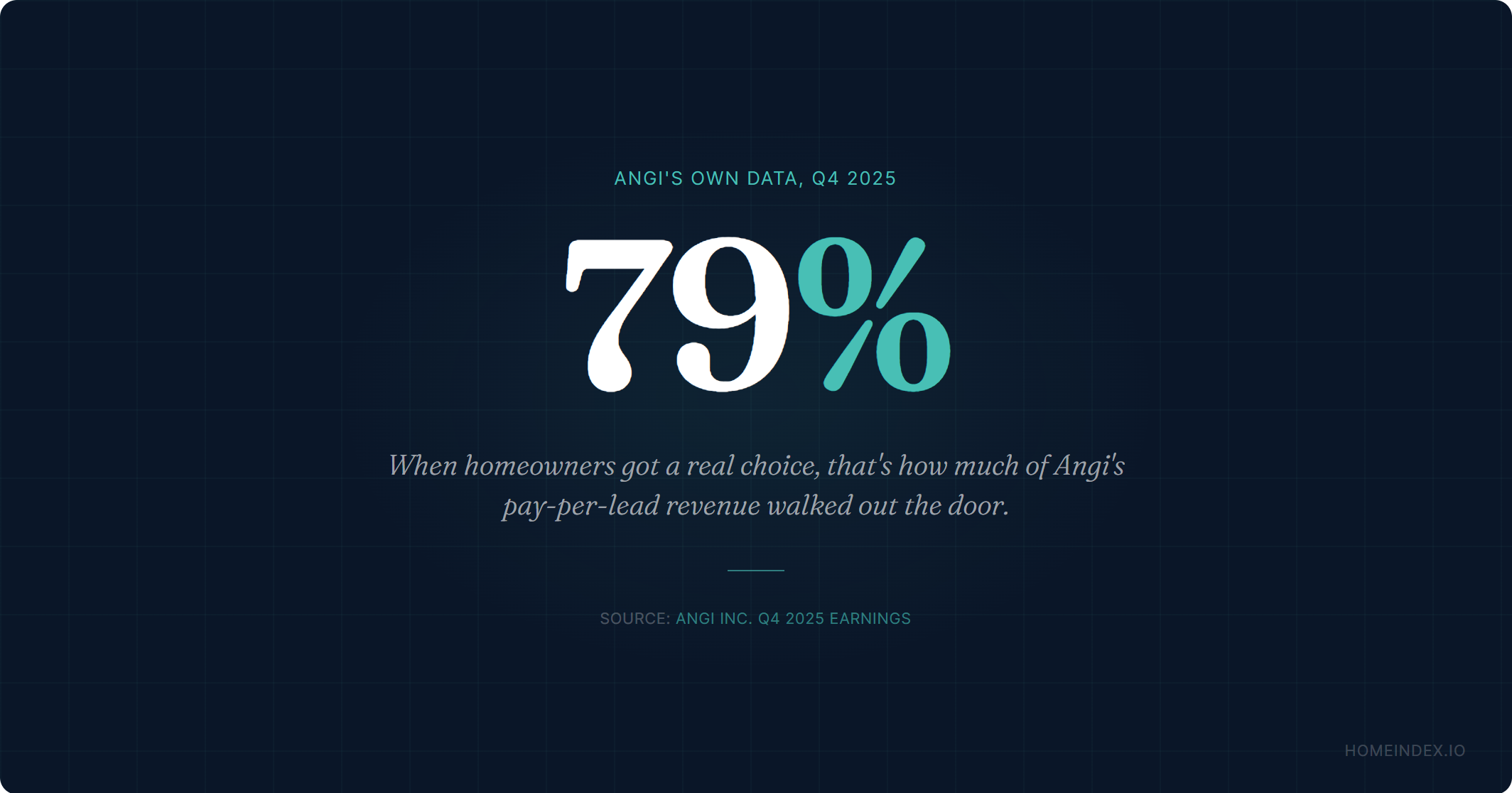
Angi's Q4 2025 Network revenue fell 79% when homeowners got to choose their contractors instead of being auto-matched the clearest public signal yet that the pay-per-lead model fails when homeowners get a real vote.
If you want to know whether the pay-per-lead model actually works for homeowners, you don't need to read another contractor subreddit thread. Just read Angi's own investor disclosures from the last two quarters. The numbers tell you everything.
Angi spent the back half of 2025 rolling out what it calls "Homeowner Choice". A system where the homeowner actually picks which contractors get to contact them, instead of the platform shotgunning their phone number to 3–8 "matching pros" the moment they finish a form. When homeowners got that choice, Angi's Network revenue, the legacy pay-per-lead business, cratered 79% in Q4. For Q1 2026, management is guiding to modest negative revenue growth with Sales & Marketing expenses rising roughly 8 points as a share of revenue, per the company's own outlook. (Angi Q4 2025 earnings call coverage)
That's not a product tweak. That's a confession.
TL;DR
- Angi rolled out "Homeowner Choice". Letting homeowners pick their pros instead of auto-matching starting January 2025.
- When homeowners got real choice, Angi's pay-per-lead Network revenue fell 79% in Q4 2025.
- Homeowner satisfaction scores rose 11 points. Contractors reported win rates up 60%+. (Angi operating update)
- The company is now planning a 12% workforce cut and an AI pivot to stabilize margins. (Angi AI pivot / workforce coverage)
- The simplest read: when homeowners can actually choose, most of them don't choose pay-per-lead.
What "Homeowner Choice" Actually Changed
Under the old Angi model, you filled out a project form, the platform auto-matched your request to contractors who were paying for that lead type in that zip code, and your phone started ringing. Multiple contractors were sold the same lead, typically three to eight, at $15–$85+ each depending on the trade. Roofing, HVAC, and full remodels sat at the top of that range.
Under Homeowner Choice, Angi shows the homeowner a set of pros and the homeowner actively picks which ones to connect with. The contractor on the other end now knows the homeowner specifically chose them not that an algorithm hit "send" on a batch of phone numbers.
The company's own data on this is unambiguous. Homeowner NPS rose 11 points post-rollout. Contractor self-reported win rates jumped 60%+. (Adapt Digital contractor platform comparison) Those aren't small deltas. Those are "we were doing it wrong" deltas.
The 79% Number Is The One To Sit With
Angi's Network segment, historically the pay-per-lead funnel, saw Q4 2025 revenue fall 79% year over year as Homeowner Choice rolled out. Proprietary channels (over 80% of the company's volume) grew. (Angi Q4 2025 earnings coverage)
Think about what that means. The company didn't remove pay-per-lead. Contractors could still buy leads. What Angi removed was the forced auto-matching. Homeowners could now decide whether they wanted the old experience or the new one. 79% of the Network revenue walked out the door.
That's homeowners voting. Not pundits, not a VC pitch deck, not the contractor Reddit. Actual homeowners, with their actual phones and actual projects, overwhelmingly skipping the "get blasted by eight calls in the next ten minutes" option when given an alternative inside the same product.
Why Pay-Per-Lead Was Always Going To Break
The economics of pay-per-lead never belonged to the homeowner. A contractor paying $55 for a roofing lead has to win roughly one in every three to eight projects to keep their customer acquisition cost from eating the job. That math forces three behaviors:
- Call fast, call hard. The first three callers usually win. That's why your phone rings 14 times in the first hour.
- Price in the lead cost. If you paid $55–$85 to talk to the homeowner, that's getting added to the quote. Every time.
- Chase volume, not fit. The contractor who "wins" is often the one with the best phone bank, not the one whose crew, schedule, or pricing actually matches the job.
None of those behaviors are the contractor's fault. They're a rational response to the platform's incentive design. The contractor is the customer in that model. The homeowner is the inventory.
Homeowner Choice reverses that. When the homeowner picks, the homeowner is the customer again. Revenue falls, because the platform can no longer sell the same "inventory" to 3–8 buyers.

The Structural Misalignment
In a pay-per-lead marketplace, the platform's customer is the contractor, not the homeowner. Contractors pay the bills. Contractor retention is the metric. This is why the product keeps getting more complicated for contractors (targeting, filters, exclusive leads, credit packs) and almost never gets materially better for homeowners (still a form, still a race to call first, still no price transparency before you pick up the phone).
Contrast this with the markets that work well for price discovery — stock exchanges, commodity exchanges, even eBay. The platform is neutral between buyer and seller. It makes money on matched transactions, not on selling access. Bid transparency is a feature, not a threat. The platform has no incentive to inflate the cost of matching, because matching is the product.
Home services has not had that market. It's had rolodex-gatekeepers charging tolls.
Read The Q1 2026 Guidance Like A Contract
Angi's Q1 2026 outlook calls for modest negative revenue growth and Sales & Marketing expenses rising roughly 8 points as a percentage of revenue, with a recovery expected later in the year. (Angi investor outlook coverage) In plain English: they have to spend more on marketing to keep volume flat, because the old per-lead re-sale multiplier is gone.
The company's response is a 12% workforce reduction and a heavier AI investment. (Angi workforce and AI coverage) That's a rational move for a public company trying to protect margin after a forced business-model transition. It's also an admission that the old revenue engine can't just be re-pointed.
Where HomeAdvisor, Thumbtack, And LSA Sit In This
Angi isn't operating in a vacuum. A few things to hold in mind:
- HomeAdvisor is part of the same Angi Inc. stack. Same economics, same transition. When Angi says "Network revenue," that's where a lot of it lives.
- Thumbtack still runs a credits-based pay-per-contact model. Credits range roughly $35–$60+ per contact depending on trade, and the same 3–8 pros often get the same job.
- Google Local Services Ads are pay-per-lead by design: HVAC $45–$80 in major metros, roofing $55–$90, water damage restoration $300+ per call. (Google LSA pricing guide) Google also quietly discontinued credits for "job type not serviced" and "geo not serviced" leads in 2025 and dispute resolution windows have stretched from 48 hours to 3–4 weeks. Contractors pay more, dispute less.
If Angi's own homeowners won't stay in the pay-per-lead funnel when given a door out, it's worth asking what happens at the other platforms the day a real door appears.
The contractor's cost per customer is not the lead price — it's the lead price divided by their close rate. If a contractor pays $60 per lead and closes 1 in 10, their real customer acquisition cost is $600. A roofing contractor working on $15,000 average tickets can absorb that. A handyman doing $300 jobs cannot. The model quietly pushes small-ticket trades out of the platform and loads up on bigger-ticket categories where the math still works — meaning the contractor ecosystem on these platforms skews toward exactly the jobs where homeowners most need price discovery.
Why We Built Home Index
We're not throwing stones from the cheap seats. We built Home Index in Charleston because we looked at that math for a long time and couldn't square it with serving homeowners honestly.
On Home Index, you post your project once. Verified local contractors review the post and submit real bids. You stay in control of who contacts you. No contractor is paying $55–$85 to talk to you, which means that cost isn't getting baked into your quote. No contractor is "winning" because they have the fastest auto-dialer.
The open-marketplace model doesn't mean "free-for-all." It means the platform gets paid by contractors for verification of things like license, insurance, background, and license and insurance are re-checked monthly so you always know who you’re dealing with. That flips who the customer is. The homeowner is the customer. The verification is the product for the contractor. Nobody's racing to call you first.
Angi's 79% number tells us the market agrees with that logic when it's allowed to.
What This Means For Homeowners Right Now
If you're a homeowner looking at a spring or summer project, the practical takeaways:
- If you've used Angi recently, you've probably noticed the shift. The "pick your pros" interface is the Homeowner Choice flow. Use it. The old auto-match flow still exists in some paths, and it's worse.
- Ask contractors directly how they found your lead. If they paid $50+ to get to you, that cost is in your quote. You can ask what the lead channel was; it tells you something about their pricing floor.
- "Top rated on Angi/Thumbtack" is a marketing badge, not an independent audit. High platform ratings track with how many leads a contractor buys, not just how good they are. (Angi vs Thumbtack vs HomeIndex honest comparison)
- Verify license and insurance independently. In South Carolina, the LLR contractor lookup at llr.sc.gov lets you check license status in 60 seconds. Do it before you sign.
What This Means For Contractors
If you're a local pro reading this and a lot of you do a few things to sit with:
- The pay-per-lead treadmill has always been a treadmill. Angi's own transition is telling you the economics are tightening. Rising CAC isn't your imagination.
- Your best economics are on homeowners who chose you. Angi's own 60% win-rate delta confirms what every one of you has felt: the call that starts with "I picked your profile" closes faster and cheaper than the call that starts with "are you the roofer who just called me?"
- Independent verification is starting to matter. Homeowners are more skeptical of platform badges than they were five years ago. A third-party verification, license, insurance, background, that you can show anywhere is worth more over time than a platform-locked ranking.
FAQ
What is Angi "Homeowner Choice" and when did it launch?
It's Angi's transition away from auto-matching to a system where the homeowner actively selects which pros to connect with. It launched broadly in January 2025 and became the dominant flow through 2025. (Angi Homeowner Choice coverage)
Why did Angi's Q4 2025 Network revenue fall 79%?
The Network segment was primarily the pay-per-lead auto-match business. When homeowners could choose directly, most stopped going through that funnel. Angi's proprietary channels (80%+ of volume) grew, partially offsetting the decline. (Angi Q4 2025 earnings coverage)
Does HomeIndex charge contractors per lead?
No. Contractors pay for verification — license, insurance, background check, re-checked monthly. Homeowners post projects free. No per-contact fee, no credits, no "your lead is going to seven other pros right now."
Does this mean Angi is shutting down?
No. The company is still large, still profitable on an EBITDA basis, and still running. It's reshaping its business model and cutting headcount to fit the new economics. The point isn't that Angi is failing — it's that the pay-per-lead model failed a consumer test when the consumer got a vote.
How should I actually choose a contractor in 2026?
Post the project in detail. Verify license and insurance independently. Get three to five real bids from pros who haven't paid to talk to you. Ask about warranty and pull-permit policy. Local references beat star ratings every time.
Post your project and get competitive bids from qualified local professionals.
Get bids from vetted Pay-Per-Lead pros
Post your project free and get bids from vetted Pay-Per-Lead pros in South Carolina.
Post Your Project Free