The HVAC Bill Nobody Warned Charleston Homeowners About
Honeywell's April 42% surcharge on R-454B refrigerant on top of the EPA's R-410A phase-out is about to hit Charleston homeowners hard this cooling season. Here's what to do in April before it becomes a July emergency.
If you have central AC installed between 2010 and 2024, April is the month to start thinking about the refrigerant inside it. It doesn't matter if your system is brand new — if it runs R-410A, this affects you. The short version: the refrigerant the entire U.S. HVAC industry used for 15 years is being phased out, the stuff replacing it just got a 42% surcharge, and the supply chain is tight enough that some contractors are struggling to get a hold of a bottle at all. If your system goes down in July, you are going to feel all of this in one bill.
Here's what's actually happening and what to do about it before Charleston's cooling season hits full stride.
The TL;DR
- The EPA required manufacturers to stop building new air conditioners and heat pumps using R-410A refrigerant by January 1, 2025.
- The replacement — R-454B, classified A2L (mildly flammable) — is now the standard for Carrier, Trane, Lennox, and York systems.
- On April 11, Honeywell notified customers of a 42% surcharge on R-454B, citing raw material costs and tariffs.
- Wholesale prices for the outgoing R-410A have jumped from $8-$12/lb to $25-$45/lb in some markets as supply tightens.
- Installation costs on new systems using R-454B are running roughly 20% higher than the R-410A equivalents they replace.
None of this shows up in a Zillow listing or a home inspection report. It shows up when your condenser leaks in August.
Why the Refrigerant Changed
Refrigerants are rated on global warming potential (GWP). R-410A, the workhorse refrigerant in U.S. residential AC systems since the early 2010s, has a GWP around 2,088. R-454B clocks in around 466 — roughly a 78% reduction. The American Innovation and Manufacturing (AIM) Act pushed the industry toward lower-GWP refrigerants, and the EPA's rule took effect January 1, 2025.
The catch is that every viable low-GWP replacement is classified A2L on ASHRAE's flammability scale — "mildly flammable" rather than R-410A's non-flammable A1 rating. A2L systems require different leak detection, different service procedures, and retrained technicians. Most major manufacturers — Trane, Carrier, Lennox, Johnson Controls/York — standardized on R-454B. A few went with R-32.
If you're buying a new system in 2026, it's coming with R-454B. That's not optional.
Why This Hits Your Wallet Three Different Ways
Way one: R-454B costs more to buy. Pre-surcharge pricing had R-454B roughly 150% more expensive than R-410A per pound. The April 11 Honeywell surcharge layers another 42% on top of that. A typical 3-ton residential system holds about 6-8 pounds of refrigerant. A leak repair that topped off a system for $250 in 2022 is now a $600-plus conversation.
Way two: New equipment costs more to install. A2L refrigerants require A2L-rated line sets, A2L-rated service valves, and technicians trained on the new procedures. Expected installation cost increases are running up to 20% versus the R-410A equivalents. On a typical Lowcountry 3-ton replacement that used to be $8,500-$11,000, you're looking at $10,200-$13,200 for the new-refrigerant version.
Way three: R-410A for existing systems is getting scarce. You can keep your current R-410A system running for its remaining life — the EPA rule doesn't force you to replace working equipment. But R-410A is no longer being manufactured, so any repair requiring a recharge is drawing from a shrinking stockpile. That's what's driving the $25-$45/lb wholesale number. Several HVAC contractors have reported that local supply houses are rationing R-454B to customers who purchased complete systems — which, in the transition period, compounds availability issues on both sides.
What Charleston Homeowners Should Do Right Now
This is Lowcountry April. Pollen is peaking, windows are still open some days, AC is running other days, and the hurricane season prep clock has started ticking. A few things matter more this month than they will in six weeks.
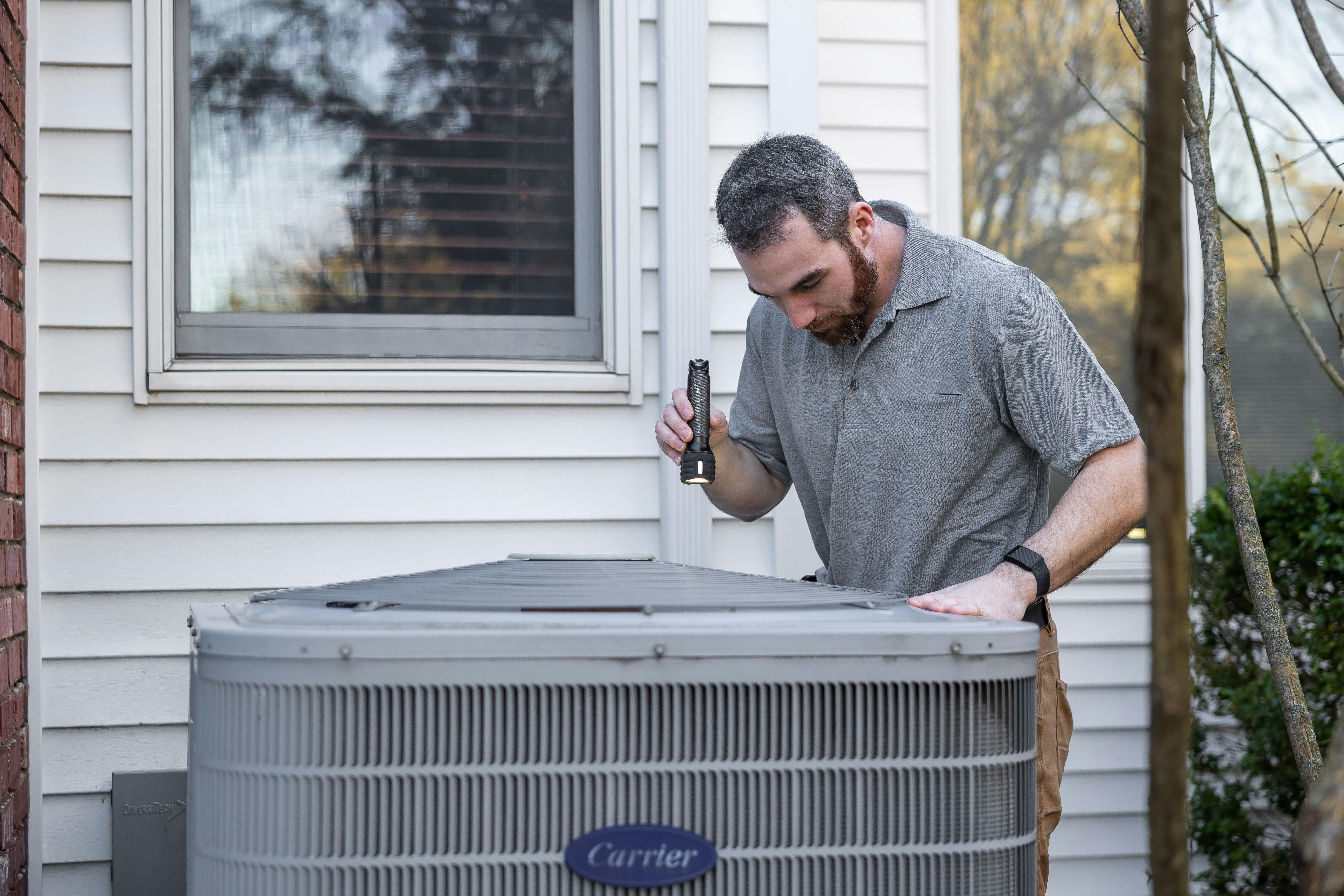
Know your system's refrigerant. Check the sticker on your outdoor condenser unit — it will list the refrigerant type (R-22, R-410A, R-454B) and a manufacture date. Or open the Home Index app, point your camera at the nameplate, and we'll read it for you and tell you exactly where you stand. In rare cases a technician may have used a substitute refrigerant after a repair — your service records would reflect this.
If it says R-22, your system is likely 15+ years old and every repair is getting harder. If it says R-410A — whether your unit is 4 years old or 14 — you're running a legacy refrigerant. That doesn't mean replace it today, but it means a major repair is a cost analysis, not a rubber stamp.
Get a pre-season inspection now, not in July. Contractor availability in Charleston between mid-May and mid-September is the tightest it will be all year. A tune-up and leak check in April catches slow leaks before they become outages. It also gives you time to get real bids on a replacement if the technician flags the system as end-of-life.
Ask for written refrigerant pricing before authorizing any repair. Given the price movement, a verbal "we'll top it off" estimate from two years ago is useless. Get the per-pound price in writing, and ask how many pounds they expect to use.
Don't panic-buy a replacement. If your system is working, you don't need to replace it before some imagined cliff. The shortage and price pressure create a real temptation to pull the trigger early — which is exactly when contractors can charge the most. A failing system needs replacing. A working system needs monitoring.
What to Ask a Contractor Bidding Your Replacement
If you're genuinely at the end-of-life point, these are the questions that separate a real bid from a sales pitch:
- Is the new system R-454B or R-32? Both are valid A2L replacements. Which one the contractor pushes usually tells you who their distributor is, not which is "better" for your house.
- What's the installed refrigerant charge, and what's the cost to top off one pound in year three? Contractors should be able to answer this without a phone call.
- Are the line sets being reused or replaced? Existing copper line sets can often be flushed and reused for R-454B, but there are cases where full replacement is required. This is a material line item.
- What's the leak detector setup? A2L refrigerants require leak detection in the indoor unit. Ask to see it on the equipment spec.
- Does the warranty require annual maintenance? Most manufacturer warranties on R-454B equipment require documented annual service. If you skip year three, year five's warranty claim can get denied.
Why This Matters for the Home as an Asset
Your HVAC system is one of the four or five biggest dollar-value items in the house, alongside the roof, water heater, electrical panel, and foundation. Until now, the age of your AC was a loose proxy for replacement cost — 10 years was cheap, 15 was getting expensive.
The refrigerant transition has compressed that timeline. A 12-year-old R-410A system that leaks in 2026 is no longer a "let's top it off and see" decision. It's a cost analysis against a new-refrigerant replacement that's 20% more expensive to install. That cost — and the reason for it — belongs in your home's maintenance record, right next to the roof age and water heater install date. When you sell in 2030, the buyer's inspector will look at a 2018 R-410A system differently than they would have in 2022.
Why We Built HomeIndex
Most homeowners don't know what refrigerant their system runs until a technician tells them mid-service call with an invoice in hand. HomeIndex's vision feature changes that. Point your camera at the nameplate on your outdoor unit — we read the refrigerant type, cross-reference the manufacture date, and tell you exactly where you stand before July. No digging through paperwork, no waiting for a contractor to deliver the news at $150/hr.
When it is time to replace, you shouldn't be feeding your contact info into a form that sells it to eight HVAC companies at $60 a pop. Post the project once. Get real bids from verified local contractors. See the math.
FAQ
Do I have to replace my R-410A system right away?
No. The EPA rule phases out manufacturing, not existing equipment. Your system can keep running for its remaining life. The calculus shifts only when it needs a major repair.
How much more will a new central AC cost than it did in 2023?
Budget roughly 15-25% more for an equivalent system, driven by the combination of refrigerant cost, A2L-rated components, and broader materials inflation — BLS reports furnaces and heaters have risen for three consecutive months.
Is R-32 better than R-454B?
Both are A2L refrigerants with similar GWP. R-32 is single-component, which simplifies service. R-454B is what most U.S. brands standardized on. For most homeowners, the right answer is whichever one your chosen contractor's brand uses — not a reason to pick one brand over another.
Can a contractor still top off my R-410A system?
Yes, but at dramatically higher per-pound costs. R-410A wholesale pricing has moved from $8-$12/lb to $25-$45/lb in many markets. Insist on written pricing before approving the work.
What about window units and mini-splits?
Same transition, same timeline. New window units sold in 2026 use low-GWP refrigerants. Mini-splits from the major brands have largely moved to R-32.
Post your HVAC project and get competitive bids from verified local contractors. homeindex.io
Sources
Get bids from vetted HVAC pros
Post your project free and get bids from vetted HVAC pros in South Carolina.
Post Your Project Free